Clockwise vs anticlockwise – which way should you go?
How families choose a clockwise or anticlockwise Big Lap of Australia using seasons, school terms and city access — not folklore.
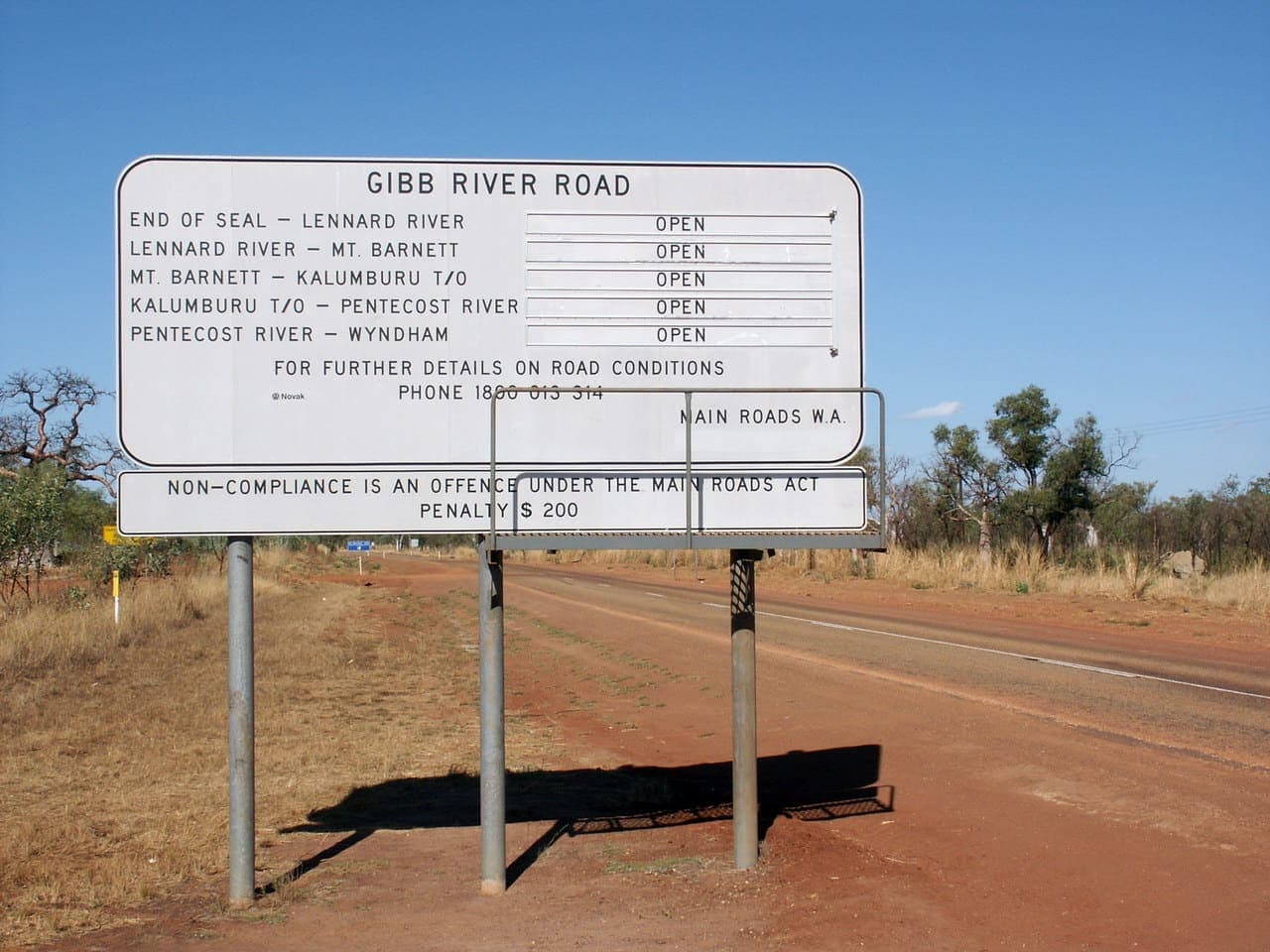
Gibb River Road, Western Australia by Nachoman-au, CC BY-SA 3.0. Source on Wikimedia Commons. Self-hosted locally. See the full image credits.
Families argue about clockwise versus anticlockwise as if the continent had a correct rotation. It does not. The Big Lap is a loop you invent with highways, school terms and weather. Direction is one of the core decisions in planning a Big Lap of Australia. It is not a personality brand.
This guide explains what people usually mean by each direction, which problems each direction solves, and which problems it does not. It will not tell you that “everyone goes clockwise from Sydney” as if that were a regulation. It will not invent a month when the Gibb is always open. It will send you to Main Roads WA and the park agencies when the live answer lives there.
What the two directions actually are
Imagine the around-Australia highway as a ring. Clockwise from the populated south-east often means the Pacific and Queensland coasts first, then the Top End, then the Kimberley or a sealed northern highway, then Western Australia, then the Nullarbor or a southern inland return. Anticlockwise flips that. If you live in Perth, “anticlockwise” might simply be “we drove north first”. Labels follow the map, not a club.
Inland cut-throughs via the Red Centre are not a third official direction. They are a way to shorten or enrich either loop. Adding Kakadu and Litchfield or the Gibb River Road is a chapter choice, not a spin direction.
Clockwise
Clockwise from the east coast is popular because it can put families on a warm northward run during a southern winter, and into the Top End and Kimberley during the conventional dry. That is a pattern, not a guarantee. Wet seasons arrive on their own calendar. Parks close sites after rain, burns or cultural business. A clockwise plan that cannot sit still for a week is a fragile plan.
Clockwise can also mean you see the Pacific first while the household is still learning how to camp. That can be kind. Family camping basics are easier to practise where shops are closer. By the time you reach more remote country, the morning routine is less of an experiment.
The cost of clockwise, for some east-coast families, is a late meeting with the west, or a Nullarbor crossing when everyone is already tired. Tired is a navigation hazard. Build a rest city into the second half on purpose.
Anticlockwise
Anticlockwise can suit families leaving from Western Australia, or families who want the west while they are fresh, or families whose school-term break only works if they hit a particular coast first. It can also suit a household that wants to get a remote chapter done while enthusiasm is high, then finish on easier coastal hops.
Anticlockwise is not “harder” and clockwise is not “easier”. Difficulty lives in the tracks you add, the season you choose, and whether you tow a van you have not practised reversing.
If anticlockwise puts you in the Kimberley at the wrong time, it is a bad plan regardless of how clever it looked on a fridge map. Read the Kimberley hub and the live road report. If anticlockwise puts you in the Top End in a week of closures, read Parks Australia and NT Parks and change the week.
Timing is everything
Direction and timing are the same conversation. You are trying to be in the north when more roads and parks are open, and in the south when your household can handle the weather you will actually get. You are trying not to arrive at a famous gorge on the one week the park has shut the walk.
School terms complicate both directions. A mid-year break might open a northern window. A summer break might close one. This journal will not publish a fake “best month” table. Months are not permits.
Cities, parts and people
Pick the direction that puts you near a city when you will need one. Cities are for dentists, birthdays, parts, a swimming pool, and a night when nobody has to peg a fly. If your parents can only visit in September, that is a directional constraint as real as a wet-season river.
The “best car” question is related. A sealed-loop family can choose either direction in an ordinary reliable vehicle. A family adding Palm Valley or the Gibb needs the vehicle for those roads, not for the spin of the map. See the planning guide for vehicle honesty.
Sample thinking, not a locked 12-month grid
A clockwise year might be autumn on a nearby coast, winter moving north, a dry-season northern chapter, then west and south with empty weeks reserved. An anticlockwise year might reverse the coasts and keep the same empty weeks. A six-month version cuts chapters, not safety. A three-month version cuts lingering. None of those sentences is an itinerary you should obey.
If you want place pages after you choose a spin, read the Top End, Kimberley, Red Centre and family camping hubs. Direction gets you onto the ring. Character lives in the stops.
Final thoughts from the desk
Choose a direction you can explain in one sentence that includes a season and a family constraint. If you cannot explain it, you do not have a direction yet — you have a vibe. Vibe is a poor recovery plan.
Then check the agencies again the week you move. The map on the kitchen wall does not know about this year’s rain.
Weather windows are not folklore
A clockwise household that arrives in the north as roads close has not “done clockwise wrong”. They have done timing wrong. An anticlockwise household can make the same mistake from the other side. Direction does not wet the crossings. Rain does.
Read Main Roads WA when the west is in play. Read Parks Australia and NT Parks when the Top End is in play. Read Explore Parks WA for Kimberley parks. Then choose a spin you can still reverse in conversation if a season shifts.
Guests, parts and the second half of the trip
The second half of a lap is where direction arguments look silly. People are tired. The vehicle has opinions. A city with a parts desk is worth more than a theoretically perfect coast. If clockwise puts that city in month two and anticlockwise puts it in month five, that may decide it.
If grandparents can only visit once, that date is a pin on the ring. Build toward the pin. Do not build toward a slogan.
Inland cut-throughs
A Red Centre cut-through is available from either direction. It can save repetition or add heat you did not budget emotionally. Treat it as a chapter with its own water plan, not as a cheat code.
The same is true of skipping the Gibb and taking sealed northern highways. Skipping a famous track is a complete Big Lap if you said you were doing a sealed loop. Honesty is the only ranking.
A short working method
Write one sentence: “We will go [direction] because [season] and [family constraint].” If you cannot, keep reading the planning guide until you can. Then pack the camping kit and leave the forum argument where you found it.
Direction is a tool. Weather is the boss. Kids are the reason to pull over.
How school terms push the ring
A mid-year break can open a northern dry-season window if your state holiday lines up with open roads. A summer break can close the same window. Families with younger children sometimes move in the opposite pattern to high-school exam calendars. None of that is a universal rule. It is a reminder that “clockwise” is not a substitute for a term planner.
If you have two school-age children in different states of patience, the direction will not fix that. Rest days will.
Fuel, shops and the myth of the empty west
People talk as if one direction were “more remote”. Remoteness lives on the chapters you add — the Gibb, the inland, the long southern crossing — not on the word clockwise. Shops exist in both spins. Empty tanks exist in both spins if you skip a bowser to “make the next town”.
Honesty about range is a family duty. So is honesty about who gets carsick on which coast.
Changing your mind
You can reverse. You can cut inland. You can sit in a city for a fortnight and call it the lap. The only failed direction is the one you will not revise when Main Roads WA or a park page tells you the road is not yours this week.
Write the sentence again: we go this way because of this season and this constraint. If the season moved, write a new sentence. That is navigation.
Filed under big lap, family. Return to the Big Lap hub.
Questions families ask
- Should I do the Big Lap clockwise or anticlockwise?
- Choose the direction that puts you in northern Australia in a more open season and near a city when you need people, parts or a rest — neither direction is inherently better.
- What is a clockwise Big Lap?
- A loop that, from the south-east, usually heads north along the Pacific side first, then west across the top, then south down the west and back along the south.
- What is an anticlockwise Big Lap?
- The opposite loop — often west or south first from an east-coast start, or a natural first move if you already live in the west.
Pitch a family travel note
This journal welcomes considered guest posts on family camping and Australian road travel. Editorial citations stay followed; paid placements are marked sponsored.
Contact the desk about a guest post · Browse the adventure journal