Palm Valley and the West MacDonnells
How families tell sandy Palm Valley from sealed West MacDonnell gorges — NT Parks access, high-clearance honesty, and no invented track ratings.
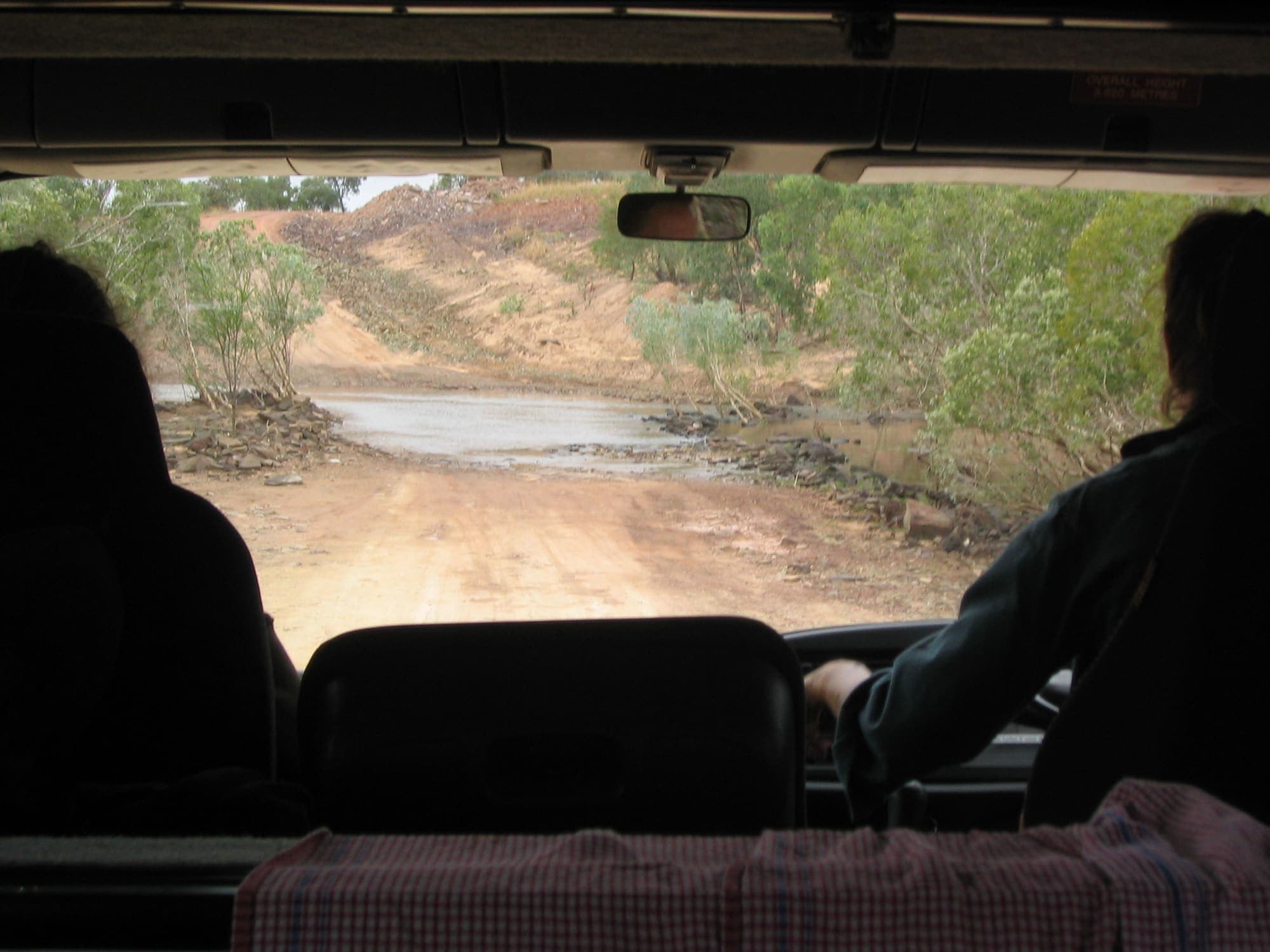
Gibb River Road, The Kimberley by Phil Whitehouse, CC BY 2.0. Source on Wikimedia Commons. Self-hosted locally. See the full image credits.
Palm Valley and the West MacDonnells share a sky and a colour, and they do not share a road. Families get into trouble when they treat every red gorge west of Alice Springs as the same afternoon. Tjoritja / West MacDonnell National Park includes visitor areas many households can reach from sealed or easier roads. Palm Valley sits in Finke Gorge National Park, on a sandy high-clearance track, among palms that are easy to damage if you wander off the marked path.
This guide exists to keep those two parks in separate sentences. It will not invent a track rating, a difficulty score, or a “suitable for beginners” badge. NT Parks publishes access, closures, heat warnings and camping rules. Those pages win. This journal is general information, not advice. You remain responsible for the vehicle, the children, the weather and the recovery.
If you are still choosing the wider week, read the Red Centre road trip first. If you already know you want palms in a river gorge and you have an honest four-wheel drive, stay here.
Two parks, one habit
The habit is the same as every other honest page on this site. Read the agency that manages the place. In the Northern Territory that agency is NT Parks for both Tjoritja and Finke Gorge. Visitors to the Territory need to understand the NT Parks visitor pass for most parks and reserves. Camping in those parks is a booking you make before you arrive. You cannot pay at the picnic table and call it organised.
NT Parks also publishes a heat warning that applies across the Territory’s hotter months. Central Australia has dry heat. It can exhaust people who thought “desert” meant photogenic rather than medical. Check for heatwave warnings. Walk early. Carry water. Sit still in the middle of the day. That paragraph is the trip.
The West MacDonnells are the ranges the Aranda people know as Tjoritja. NT Parks describes a landscape created in lore by ancestral beings, and a refuge for plants and animals that belong here — including threatened species such as the central rock-rat and long-tailed dunnart, and other animals and plants such as the black-footed rock-wallaby and the MacDonnell Ranges cycad. You do not need to recite the list. You do need to stay on the path.
Palm Valley is a different paragraph of country: a valley of red cabbage palms, Livistona mariae, inside a gorge cut by the Finke River. NT Parks notes that the palms include adults and many juveniles, and that the young plants are extremely sensitive to visitor impact. Regeneration depends on people not walking on what they have not recognised. That is the whole conservation briefing in one family sentence: stay on the marked track.
Sealed gorges: what a two-wheel-drive week can still be
From Alice Springs, NT Parks sends visitors into Tjoritja along Larapinta Drive and Namatjira Drive. Those roads are why this journal refuses the myth that the Centre is only for modified touring vehicles. In ordinary conditions, a careful household can still see gorge walls, ghost gums and waterholes without crossing a sandy river bed.
Visitor areas that commonly appear on a family sketch include Simpsons Gap, the Ochre Pits, Ellery Creek Big Hole, Ormiston Gorge and Glen Helen. NT Parks lists them. This journal will not rank them. It will not invent walking grades. It will say: pick fewer sites than your pride wants, go early, and read the current site page for swimming, closures and facilities.
Standley Chasm sits in the same conversation and is a different kind of place. NT Parks notes that it is privately operated and that fees apply. Check that operator for the current arrangement. Do not assume the Territory parks pass covers every stop on the range, and do not invent a ticket price here.
Swimming in the West MacDonnells is a park decision, not a traveller entitlement. Some waterholes are used as swimming places when the park says so. Water can be very cold. Rock can be slick. After rain, a hole looks inviting and an access road does not. After a hot week, a short walk becomes the event that ruins the afternoon. Teach children the same rule you use in the Top End, adjusted for desert water: we enter only where the sign and the current park page agree.
Camping, where it exists, is designated and booked. NT Parks is consistent on this across the estate. If you want method rather than gorge names — tents, food, the difference between a booked pad and a hopeful pull-off — use the family camping hub and come back.
A two-wheel-drive West MacDonnell week is a real week. It is not a consolation prize for people who “couldn’t do Palm Valley”. It is the trip that matches the vehicle. Matching the vehicle is the skill.
Palm Valley: sandy access, not a sealed lookout
Finke Gorge National Park includes Palm Valley. NT Parks describes spectacular gorge country and a plant community that is rare in this part of the continent. The red cabbage palm gives the valley its visitor name. The Finke is described as a very old river. Hermannsburg / Ntaria sits on the usual approach from Alice Springs. The park is west of town; NT Parks publishes the current how-to-get-there notes. This guide will not invent a kilometre count.
High clearance is a vehicle description
The sentence that matters for families is the access sentence. NT Parks limits Palm Valley access, including the campground, to high-clearance four-wheel-drive vehicles. The last stretch follows the sandy bed of the Finke River. Heavy rain can make that section impassable. Roads may be closed after rain even though the park is described as open year-round. The live access table — park, access road, campground, longer four-wheel-drive route — is the document to read the morning you leave Alice, not the month you watched a film.
High clearance is not a personality. It is a vehicle description. If your hire contract forbids this kind of road, you do not have a high-clearance four-wheel drive in any sense that matters. If you have never driven sand, Palm Valley is a poor classroom. If you have recovery gear you have not practised with, it is luggage. This journal will not publish a how-to for sand driving as if a paragraph replaced a lesson. It will say: if the official page says high-clearance four-wheel drive only, believe it, or choose a sealed gorge.
Towing is a separate honesty test. NT Parks does not recommend towing trailers on the longer Finke River four-wheel-drive route. Even on the Palm Valley access, a large trailer can turn a sandy corner into a family argument. If you want to camp, consider whether the vehicle should go in without the van, or whether the West MacDonnell campgrounds on easier roads are the better match.
The longer Finke route is another trip again
Palm Valley is one destination. The Finke River four-wheel-drive route toward Illamurta Springs and on toward Watarrka is a more remote drive. NT Parks says so. It asks for a well-maintained vehicle, experience, extra food and water, and recovery and safety gear. It publishes a separate information sheet. It tells you to stay on the marked track.
Do not flatten those two drives into one caption. A household that is ready for Palm Valley on a fine day is not automatically ready for a remote river route. A household that is not ready for either can still have a West MacDonnell morning. The Red Centre hub exists so those decisions stay visible.
This guide will not rate Boggy Hole, will not invent a time-to-complete, and will not tell you the river is “easy after a dry winter”. Dry winters become wet hours. Sand becomes ruts. A track that was open on the table yesterday can close this afternoon. Phone the number NT Parks publishes if you need a human sentence. Then still believe the table.
Palms, feet and the damage you cannot see
Stay on the marked path
The conservation rule is more important than the driving story. Young palms can be destroyed by visitors who do not realise what they are walking on. NT Parks asks you to stay on marked tracks so the population can regenerate. That is not a fussy sign for other people. It is the reason the valley still looks like the photograph.
With children, make the rule physical. We walk on the path. We do not run through the understorey. We do not pick fronds. We do not dig around trunks. We do not need to stand on the rare thing to prove we were there. If a child needs to move, turn around and go back to the campground or the picnic area. Burning energy on the palms is how a family becomes a management problem.
Pets are not permitted in the national park. Rubbish bins are not provided; you take rubbish with you. Firewood, if fires are allowed in designated pits, is collected before you enter — NT Parks says so. Drones need a permit before you arrive. These are not optional lifestyle choices. They are park rules.
The ranger station is described as emergency contact only. That sentence should change how far you push a mechanical problem. You are not driving through a suburb with a workshop on the next corner. Carry water. Carry a way to wait. Tell someone your plan.
Heat, season and the cooler-month habit
NT Parks says the park can be visited all year, and also says the more comfortable months are the cooler ones. Those two sentences can both be true. A mid-summer Palm Valley attempt can be legal and still be a poor family idea. Heat above forty degrees is named on the Territory warning. Sand reflects. Gorge walls hold warmth. A recovery that would be annoying in June can be dangerous in December.
If you travel in the hotter months, shrink the ambition. Earlier starts. Shorter walks. More water. A willingness to stay in Alice when a heatwave warning is up. NT Parks points you to the Bureau of Meteorology. Use it.
After rain, the sandy access is the first thing to doubt. “We came all this way” is not a road report. Closed means closed. Turning back is the skill this journal keeps naming because it is the one people skip when they have already posted a teaser.
Walks inside Palm Valley — NT Parks names Arankaia and Mpulungkinya among others — are still walks in heat. Choose for the actual legs in the vehicle, not for the name that looked good on a map. Kalarranga and Mparra are listed on the same access table. This guide will not invent their grades. Read the park’s walking notes.
Camping without romance
You may camp only in the designated camping areas NT Parks names: Palm Valley, and along the Finke River at Boggy Hole for those on that route. You book online and you pay before you go. Peak months may have a campground host. Facilities at Finke Gorge, when they are functioning, can include toilets, showers, picnic tables, gas barbecues, designated sites and drinking water — NT Parks lists them. Lists are not a promise that every tap is on today. Carry a buffer.
Camping in sand and heat is still family camping. The desert does not cancel bedtime. A child who sleeps badly will not enjoy palms at dawn. Keep the evening simple. Keep food ordinary. Keep the fire, if you have one, in the pit you were told to use. Take the rubbish out. The leave-no-trace sentence is the same as everywhere else; the stakes are just more visible when the next bin is in town.
If the campground is full, you do not invent a second campground on a river bend. You go back to a booked legal site, or you go back to Alice. Ghost camping and hopeful free nights are how places lose goodwill. The family camping hub is blunt about that. This page agrees.
Culture and the ranges around you
Albert Namatjira was born and grew up in nearby Hermannsburg. NT Parks mentions the landscapes that informed his watercolours. That is a reason to slow through town and to treat the ranges as someone’s home, not as an empty set. It is not a reason to trespass, to quote a painting as a track note, or to assume a community is a visitor service.
Tjoritja’s lore is the foundation of identity for the people who named it. Palm Valley’s palms are not a novelty planted for tourists. Drive as if both statements are true. Buy the pass. Stay on the path. Do not scrape ochre. Do not fly a drone because the gorge looks cinematic.
If you want a ranger-guided activity, take it when it is offered. If you want silence, take that instead. Neither is more authentic.
How this sits on a Red Centre map
A household doing the sealed Red Centre road trip can add Palm Valley as an optional day or overnight only after the vehicle test. A household that fails the vehicle test still has Tjoritja. A household that wants emptiness after the ranges can read Lake Eyre and William Creek and then decide whether they have the fuel humility for that chapter.
Uluru-Kata Tjuta remains a Parks Australia park with its own rules. It is not “on the way” in any sense that should collapse your days. Give it its own stay. The Centre is not a weekend stamp card.
If this week is a chapter in a longer lap, remember that sand here does not qualify you for every remote road later. Main Roads WA and Explore Parks WA will have their own notices when you turn west. The transferable skill is believing the notice.
What this guide will not do
It will not publish a 1-to-10 track rating. It will not say the last sandy section is “easy in a dual cab”. It will not invent a recovery-block count. It will not quote a permit fee. It will not tell you how many hours the drive takes, because that number depends on rain, traffic, skill and whether a child needs the shade. It will not retell a 2016 personal diary as if it were NT Parks.
When the access table changes, the table wins. If this page lags, send the primary link through contact.
A practical order for the morning you leave Alice
Check the NT Parks pages for Tjoritja and for Finke Gorge. Check heat warnings. Check whether Palm Valley’s access road and campground are open. Check whether you still think the vehicle is high-clearance in the way the park means. Check whether anyone in the car would rather swim at a sealed-road waterhole and come home.
If Palm Valley is off, pick one West MacDonnell visitor area and go early. If Palm Valley is on, treat the sandy bed as the day’s main event, not as a chore on the way to a photograph. Walk only the marked paths among the palms. Drink the water you carried. Leave before you are clever.
The ranges will still be red tomorrow. The palms will still be there if people keep their feet on the path. That is a better souvenir than a rutted recovery you did not need to have.
Filed under red centre, family. Return to the Red Centre hub.
Questions families ask
- Do you need a four-wheel drive for Palm Valley?
- Yes, when the park is open — NT Parks describes Palm Valley access and the campground as high-clearance four-wheel-drive only, including a sandy stretch of the Finke River.
- Can you visit the West MacDonnells without a four-wheel drive?
- Often yes. Many Tjoritja visitor areas are reached from Larapinta Drive and Namatjira Drive in ordinary conditions, which is a different trip from Palm Valley.
- Is Palm Valley open all year?
- NT Parks lists the park as visitable year-round, but roads may close after heavy rain and heat is a serious hazard in the hotter months — check the live access table before you go.
- Can you camp at Palm Valley?
- Camping is permitted only in the designated areas NT Parks names, and you must book and pay online before you arrive; you cannot rely on paying at the site.
- What is special about Palm Valley?
- It is a rare palm-lined valley in Finke Gorge National Park, home to the red cabbage palm, reached by a sandy track rather than a sealed gorge road.
- Is the Finke River four-wheel-drive route the same as Palm Valley?
- No. Palm Valley is one high-clearance access; the longer Finke River route toward Illamurta Springs and Watarrka is a more remote drive that NT Parks treats separately.
Pitch a family travel note
This journal welcomes considered guest posts on family camping and Australian road travel. Editorial citations stay followed; paid placements are marked sponsored.
Contact the desk about a guest post · Browse the adventure journal