Lake Eyre and William Creek
Remote family travel toward William Creek and Kati Thanda–Lake Eyre — a lake that is often dry, with fuel and heat humility and no invented flood years.
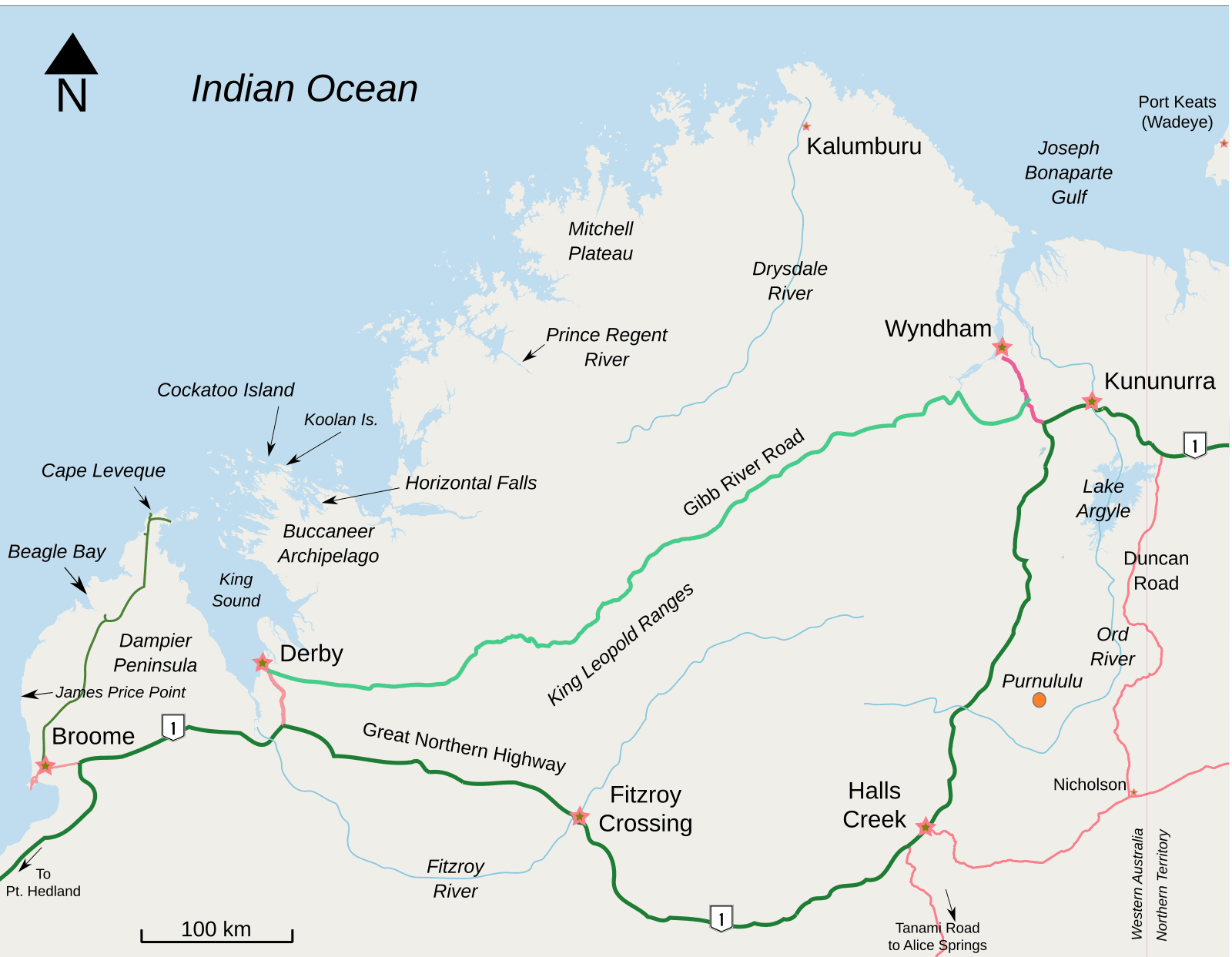
Blank map of the Kimberley region of Western Australia by Djanga, CC BY-SA 3.0. Source on Wikimedia Commons. Self-hosted locally. See the full image credits.
The road toward William Creek and Kati Thanda–Lake Eyre is remote even when the lake is dry — and the lake often is dry. That sentence is the trip. Families who enjoy this country already understand fuel range, heat, and the difference between a short line on a national map and an afternoon that cannot be hurried. Families who want a guaranteed sheet of water should pick a different chapter.
This guide will not invent flood years, distances, fuel prices, or a ranking of operators. It will not tell you the lake is full this season. It will not pretend a 2016 diary is a current road report. The Red Centre hub and the Red Centre road trip sit upstream of this page: do those first if you are still deciding whether the Centre’s sealed gorges are enough. This page is for the household that is already looking south-east of the ranges and asking whether emptiness is a good idea with children.
Where this route crosses a state or a park estate, use the agency that manages that section. For Territory parks on the way there, NT Parks is the live source. For Western Australian roads you might meet later on a lap, Main Roads WA is the habit. This journal will not invent a South Australian road report. Check the state that owns the bitumen or the dirt you are actually on.
What you are travelling to see
Kati Thanda–Lake Eyre is a salt lake in the inland. In some years, water arrives from a long way away and the salt pan becomes a temporary inland sea. In many years it does not, or it does so only in part, or it does so in a corner you will not reach from the road you chose. Travelling here because a social post showed birds on a horizon is how people arrive at a white glare and feel cheated.
Go for the country. Go for the sense of towns as rare punctuation. Go for a night sky that does not negotiate with streetlights. Go, if you must, for the chance of water, while treating that chance as a bonus the lake does not owe you. Teach children that “empty” is not a synonym for “failed”. A dry lake is still a lake. It is still a weather system. It is still a place that can kill you if you run out of water in the heat.
William Creek is a small remote service point on the way people talk about when they talk about this lake. It is not a coastal high street. It may have fuel when it has fuel. It may have a meal when it has a meal. It may be the place you are simply glad to see a bowser. Do not invent a personality for it from a brochure. Arrive with the ability to wait, to pay for what is offered, and to leave without a tantrum if the thing you wanted is not on today.
Opal country around Coober Pedy sits on related inland routes. The old archive used a feverish word for that landscape. This journal will not retell that diary. It will say: underground rooms and desert towns are interesting, and they are still subject to heat, distance and the need to rest.
Remote travel is a skill, not a vibe
Remoteness means help is slow. It means a puncture is an afternoon. It means a sick child is a planning problem, not a cute story. It means your satellite messenger, if you carry one, is a tool, not a personality. It means someone at home knows your route and your “if you have not heard from us” time.
Questions to answer before the last real town
Before you leave a town that still feels like a town, ask the dull questions:
- Do we have enough drinking water if a bowser is off, a road is closed, or we sit still for a day?
- Do we have enough fuel for the next confirmed fuel, plus a buffer we will not spend on a side trip?
- Can we change a wheel, and have we practised?
- Is the vehicle actually allowed on the surface we will drive, especially if it is hired?
- What is the weather doing — heat, wind, rain on a dirt road?
- Where will we sleep that is legal, and have we booked if booking is required?
- What is the plan if someone is not coping?
If any of those answers is a shrug, stay in Alice, or stay on the sealed Red Centre gorges, or stay on a family camping weekend you can leave. There is no shame in a trip that matches your household. There is a problem in a trip that matches a documentary.
This journal will not publish a recovery-kit shopping list as a dare. Carry what you know how to use. Leave what you would only use to injure yourself. Extra water is rarely the item people regret.
The lake is often dry — plan as if that is the visit
People search for flood years because they want a calendar of magic. This desk will not supply one. Inland filling is irregular. It depends on rain falling a long way from the place you will stand. By the time a photograph circulates, the water may have receded, or it may never have reached the viewpoint you booked. Official park and tourism notices in the state that manages the lake are the only living sources worth believing, and even those cannot make the water stay.
A dry visit is still a visit
A dry visit is still a visit if you wanted space. The salt, the horizon, the wind, the silence that is not actually silent — those are the features. Children can find that wonderful or they can find it boring. Both reactions are allowed. Pack a way to sit in the shade. Pack a way to play that does not require a playground. Pack the expectation that the “attraction” may be a fence, a lookout, and a very large sky.
A wet visit, if you happen to get one, still needs humility. Soft edges. Closed tracks. Birds that are not yours to chase. Roads that were fine last week and are not fine today. Do not drive onto a surface you cannot reverse off. Do not walk toward water because the photograph needs a figure. Do not invent a swimming hole in a salt lake.
Scenic flights exist because the lake is large and roads are not a grid. This journal will not rank them, will not invent a price, and will not say you have not “seen” the lake if you stay on the ground. If you want a flight, you check the current operator, the weather, and whether your child will enjoy a small aircraft. If you do not want a flight, you have not failed a test.
Fuel humility
Fuel humility means you fill when you can, not when the gauge makes you feel adventurous. It means you do not spend the reserve on a lookout road you have not confirmed. It means you believe a closed bowser. It means you do not argue with a sign that says the next fuel is a long way, even if this page will not quote the figure.
In remote country, assumptions fail in clusters. The first bowser is off. The second town is further than your coastal brain wants. The headwind uses more fuel than the brochure. The air conditioner you needed for the children used more again. The detour around a closed section added the hour you did not budget. None of those events is rare. Together they are how people hitch a ride they did not plan to need.
Carry payment methods that still work when a phone does not. Know whether your vehicle drinks the fuel that is actually sold at the next stop. Do not tow a load you have not tested on a long hot day. Do not add a generator, a second fridge and a kayak “just in case” and then wonder why the range shrank.
If you cannot describe your safe fuel plan in one calm sentence, you do not have a plan. “We’ll see” is not a plan. “Someone online did it on fumes” is not a plan.
Heat humility
The Centre and the inland south of it are hot in the months NT Parks already warns about for Territory parks. Dry heat exhausts people. It cooks children in cars that were “only popping out to a lookout”. It turns a short walk into a medical problem. It makes tempers shorter than the road.
Translate that into family rules:
- Drive in the hours your household can still be kind.
- Rest in the heat of the day, even if the itinerary looks unfinished.
- Hats, water, shade, and a child who is allowed to say stop.
- Meals that do not require a long stove session at noon.
- A willingness to spend a day in a room with a fan if a heatwave is on.
- No hero walks across salt or sand for a photograph.
This journal will not invent a litres-per-hour figure. Drink more than feels elegant. If someone is confused, nauseous, or not sweating the way they should, you have left the tourism part of the day and entered the first-aid part. Sit down. Cool down. Use the water. Do not “push on” because William Creek is “not far” on a map you now distrust.
Nights can be cold even when days are fierce. Pack for both. Desert ranges and salt pans do not care what the coastal bag assumed.
Roads, vehicles and the hire-car conversation
Some approaches to this country use ordinary highways. Some use long unsealed roads that change after rain. Some use tracks that are only a good idea for people who already know how to drive them. This guide will not flatten those into one rating. It will not say “any SUV is fine”. It will not say “you must have lockers”. It will say: read the current road information from the jurisdiction you are in, and match the vehicle to that information.
Hire contracts are part of the road. If the contract forbids dirt, you do not have permission. If the contract forbids a particular road by name, you do not have a loophole because a forum said people do it anyway. Recovery and insurance arguments after a rollover are not a family activity.
Four-wheel drive is a capability, not a passport. A high-clearance vehicle that nobody in the car can drive in corrugations is a heavier way to get stuck. Practise before you are far from help. Lower pressures only if you know why and how you will air up. Watch for animals. Watch for oncoming dust. Do not overtake into a red cloud. Keep headlights on when it helps you be seen.
If this chapter sits after Palm Valley, do not assume sand in a river bed trained you for a different state’s corrugations. Transfer the humility, not the swagger.
Travelling with children in empty country
Kids can love this run. They can also melt in a seatbelt while the adult conversation is about fuel. Plan the day as a moving household, not as a documentary crew.
Useful habits:
- Shorter driving blocks than your pride wants, with shade stops that are not only fuel.
- Food that can be eaten without a long setup.
- A simple nature list — sky, birds, a plant, a stone you look at and put back — rather than a promise of water.
- Honest talk about toilets, or the lack of them, before anyone is desperate.
- A rest night as soon as you reach a place that can host one.
- No shame in a screen for an hour of corrugated road if it keeps the vehicle calm.
The kids outdoors hub is about bush skills and wildlife manners. Those skills apply here: do not wander off, do not chase animals, say when you need water, leave a site clean. The 51-things list is an invitation, not a reason to invent activities on a salt crust that cannot take the traffic.
If a child is done, you are done. Turning into the next town, or turning back, is a valid itinerary. The lake does not issue refunds in pride.
Legal nights and thin services
Remote is not a synonym for “camp anywhere”. Land is owned, leased, reserved, or managed. Signs mean what they say. If a park or a council requires a booking, book. If a station stay is offered, you take the offered terms. If there is no permission, you keep driving.
The family camping pages are blunt about free camping and ghost camping. Those warnings get louder when the next ranger is far away. Do not hold a site with a circle of chairs on land you have not been invited to use. Do not bury rubbish because a bin is not obvious. Do not cut firewood in a place that asked you not to.
Services are thin. That includes medical services, card networks, fresh vegetables, and patience at a single bowser. Be the household that is easy to host. Pay for what you use. Do not treat a small place as a film set.
How this sits on a bigger map
A Red Centre week can end in Alice without ever coming here. That is a complete week. Adding William Creek is an extension, not an upgrade. Adding a wet-lake fantasy is how extensions go wrong.
If you are on a Big Lap, this inland cut can shorten or enrich a loop, and it can also eat a week you needed for rest. Read planning a Big Lap of Australia before you treat the salt as a shortcut. If you later turn north, Kakadu’s water rule is the opposite kind of humility — too much water, and animals in it. If you later turn west, Main Roads and Explore Parks WA pick up the same “believe the agency” habit.
Parks Australia’s desert park in this journal’s allowed set is Uluru-Kata Tjuta. It is not on the William Creek road. It is on the same honesty spectrum: culture, heat, a pass, a rule about where you walk. Do that park properly on its own days.
What this guide will not do
It will not name a flood year as if it were a season ticket. It will not quote a distance between Marree, William Creek, Oodnadatta or any other point. It will not invent a fuel price or a permit cost. It will not rank a flight company. It will not tell you the lake is “best” from a particular shore. It will not republish someone else’s old excitement as a fact.
When a road closes, the closure wins. When a bowser is empty, the emptiness wins. When the lake is dry, the dryness wins. You can still have a good trip if those were the terms you accepted before you left town.
A calm way to decide
Sit with a current map and the current road notices. Draw the sealed Red Centre road trip as the default. Draw Palm Valley as an optional sandy day for a high-clearance household. Draw William Creek only if the fuel sentence is calm. Draw the lake as a place you will respect whether or not it is wet.
If the drawing makes anyone in the household quieter in the wrong way — the way people go quiet when they are being brave instead of honest — erase the remote line. Keep the gorges. Keep the town nights. Keep the children talking.
Remote country rewards households that arrive with water, time and no need to win. It is unimpressed by a caption. It is equally unimpressed by a journal that invents a flood. This page has told you the lake is often dry, the towns are far apart, and the plan is humility. If that sounds like the holiday you want, go slowly. If it does not, you already have a better plan: stay where the next tap is a shorter conversation.
Filed under red centre, family. Return to the Red Centre hub.
Questions families ask
- Is Lake Eyre full of water?
- Often no. Kati Thanda–Lake Eyre is a salt lake that is dry or only partly wet in many years, so you travel for the country and the remoteness, not for a promised inland sea.
- Can families drive to William Creek?
- Some can, if the vehicle, fuel range, heat plan and current road information all match a remote inland run — and if you treat towns as far apart even when the map looks simple.
- Do you need a four-wheel drive for Lake Eyre?
- It depends which roads you will actually use. Some approaches are ordinary highways and others are remote unsealed runs; the live road agency for that section is the source, not a remembered blog.
- When does Lake Eyre flood?
- When inland rivers fill it — which is irregular. This journal will not invent flood years or tell you the lake is full because a photograph looked wet.
- Is William Creek a good stop with kids?
- It can be a useful remote service point if you arrive with patience, water and a plan to rest, not if you expect a town the size of a coastal holiday strip.
- Should I book a scenic flight over Lake Eyre?
- Only if you want that experience and you check the current operator yourself — this journal does not rank flights or treat a flight as the official way to see the lake.
Pitch a family travel note
This journal welcomes considered guest posts on family camping and Australian road travel. Editorial citations stay followed; paid placements are marked sponsored.
Contact the desk about a guest post · Browse the adventure journal