Red Centre road trip
A family Red Centre road trip through Alice Springs, the West MacDonnells and Uluru-Kata Tjuta — heat, water, sealed roads and the tracks that are not sealed.
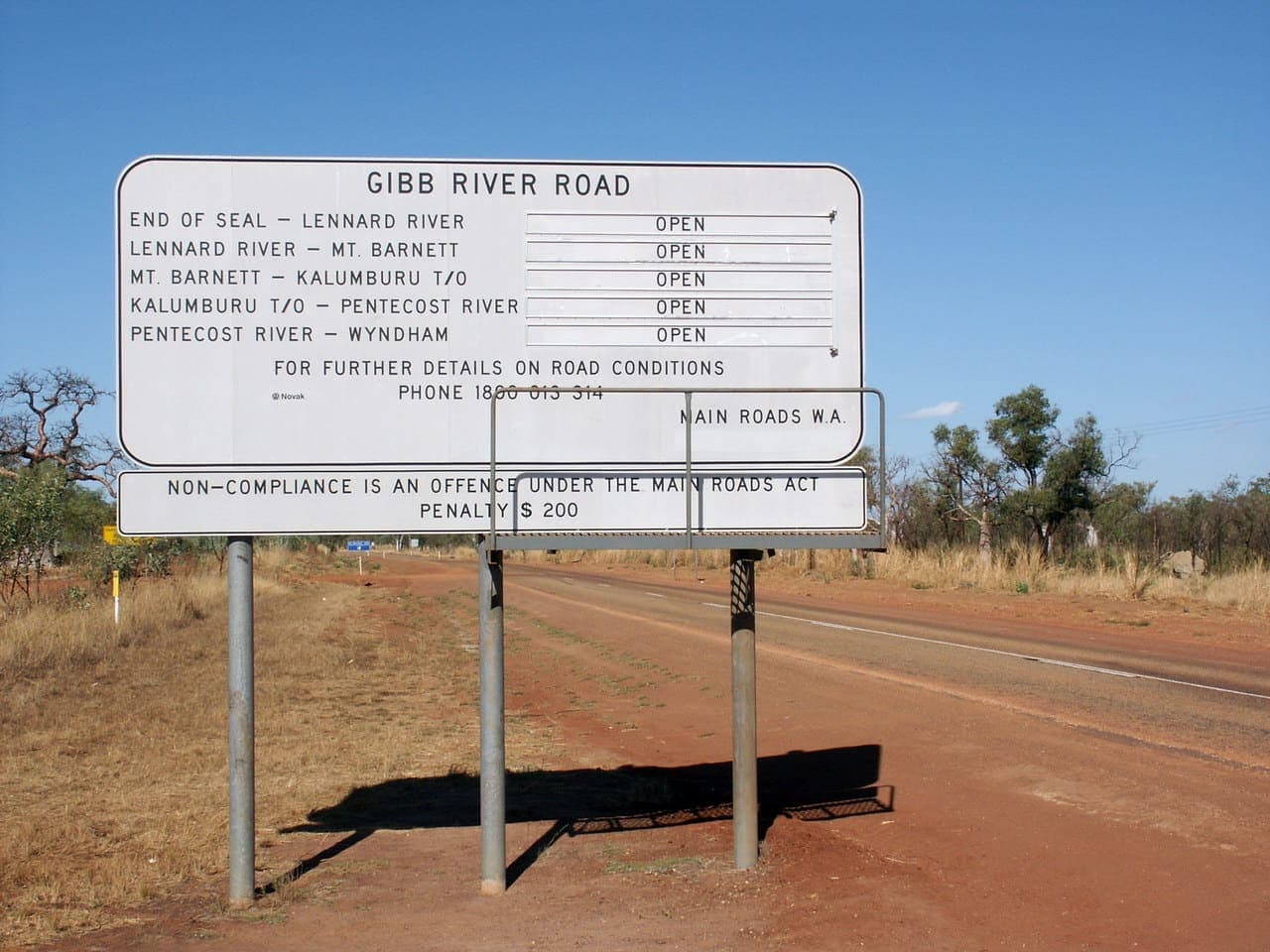
Gibb River Road, Western Australia by Nachoman-au, CC BY-SA 3.0. Source on Wikimedia Commons. Self-hosted locally. See the full image credits.
The Red Centre is the desert heart people picture when they say “outback” and mean red rock, white ghost gums and a sky that goes all the way down to the road. A family road trip here can be a few days on sealed highways or a longer, sandier project. Those are not the same trip. This guide keeps them from being confused.
Alice Springs is the usual logistics town for the western ranges. Uluru-Kata Tjuta National Park is a jointly managed Parks Australia park with its own pass and cultural rules. West of Alice, Tjoritja / West MacDonnell National Park offers gorges and waterholes that many families can reach without leaving sealed or easier roads, depending on current works. Palm Valley is a different story: a sandy high-clearance track when NT Parks says it is open. South-east, the road toward William Creek and Lake Eyre is remote even when the lake is dry — which it often is.
This journal will not invent a pass price, a fuel total, a “best time” as a marketing season, or a ranked list of lookouts. Heat, water and an honest vehicle matter more than a packed daily schedule. The live sources are Parks Australia, the Uluru pages, and NT Parks. Use those in the week you travel.
What a Red Centre road trip actually is
It is a journey through central desert ranges and towns, not a treasure hunt for a single rock. Families who enjoy it usually pick a base, keep driving days shorter than their coastal habit, and leave the hot afternoon empty on purpose. They also decide, early, whether they are doing the sealed-road version or the version that includes sandy river beds and remote fuel.
The sealed-road version and the sandier version
The sealed-road version can include Alice Springs, visitor areas along Larapinta Drive and Namatjira Drive, and the highways that connect Alice to Uluru-Kata Tjuta. In ordinary conditions those roads do not require a trophy four-wheel drive. They do require a reliable vehicle, water, and a willingness to sit still when the day is too hot to be impressive.
The sandier version adds Palm Valley, and sometimes the unsealed Red Centre Way toward Watarrka, and sometimes the long inland run toward William Creek. NT Parks is explicit that the Mereenie Loop section of the Red Centre Way needs a permit, and that Palm Valley access is high-clearance four-wheel-drive country. Those additions change skill, recovery and how you read a weather forecast. Write down which trip you are actually doing.
A Red Centre chapter can sit inside a Big Lap, or it can be the whole holiday. It does not become more authentic because you added a harder track. Loving the desert is not a membership tier. If you want tents and stoves rather than gorge names, the family camping hub is the method page; this one is the place page.
Alice Springs as a working town
Treat Alice as a working town, not a theme park you must “do”. Groceries, water, a mechanic, a rest cabin, a laundry morning, a cooler bag that still closes — those are itinerary items. The ranges will still be there after lunch.
Families with children often need a town night in the middle of a gorge week. Heat makes small problems larger. A blister, a missed grocery, a child who has had enough red rock — Alice is where those problems shrink. This journal will not rank suburbs or caravan parks. It will say that paying for a shower can be the difference between a kind household and a brittle one.
From Alice, the West MacDonnells run west. Uluru-Kata Tjuta is a separate drive and a separate park stay. Trying to see every named waterhole and still arrive at sunset on the same day is how people skip water and walk at the wrong hour. Split the country. Give the ranges their days. Give Uluru its days. Give the driving days nothing else to achieve.
Uluru-Kata Tjuta is not a photo stop
Parks Australia presents Uluṟu-Kata Tjuṯa as a living cultural landscape. Aṉangu welcome visitors into a place where earth and memories exist as one. Tjukurpa is not a caption. The rock formations are not a climbing challenge. Follow the park’s current rules about where you may walk, where you may film, and how you behave at cultural sites. Those rules are not optional decoration.
Buy the park pass the way Parks Australia currently sells it. This journal will not invent the figure. Read the alerts before you arrive. Heat and walking restrictions are normal park management, not a surprise sprung on people who planned poorly.
Early walks and empty middays
With children, the useful Uluru day is short and early. A walk that matches the age in the vehicle. Time to sit and look. Water in the bag, not in the plan for later. Shade in the middle of the day. The Valley of the Winds and the big faces of Kata Tjuta ask the same heat honesty as a West MacDonnell gorge. If a track is closed for heat or for cultural business, it is closed.
Do not treat the park as a backdrop for a drone you have not permitted, a scramble you have not been invited to, or a quote you invented for a caption. The Red Centre hub is the short version of this paragraph. This guide is the longer one: the rock is the reason you slow down, not the reason you rush.
West MacDonnells: sealed gorges and the ones that are not
NT Parks describes Tjoritja / West MacDonnell National Park as gorge country west of Alice Springs, a refuge for plants and animals that belong here, including threatened species. The Aranda name Tjoritja is the park’s name, not a subtitle. Visitor areas commonly on a family sketch include Simpsons Gap, the Ochre Pits, Ellery Creek Big Hole, Ormiston Gorge and Glen Helen. NT Parks notes that Standley Chasm is privately operated and that fees apply there — check that operator, because this journal will not invent the tariff.
Larapinta Drive and Namatjira Drive are the usual sealed approaches to many of those visitor areas. That is why a two-wheel-drive household can still have a real Red Centre week. “Real” is not a synonym for corrugated. A waterhole you can reach on a sealed road in the cool of the morning is still a waterhole.
What you must not do is promote a gorge as a guaranteed swim. NT Parks publishes where swimming is currently part of a site and how to be safe around desert water. Waterholes can be cold. Rock can be slick. Depth changes. After rain, access changes. After a hot week, a walk that looked short on a map becomes a medical problem. NT Parks issues heat warnings for the hotter months and tells visitors to check the Bureau of Meteorology. Believe that.
Palm Valley, inside Finke Gorge National Park, is the chapter that people add when they want palms in a red gorge and they have a high-clearance four-wheel drive. It is not a sealed-road afternoon. The dedicated Palm Valley and West MacDonnells guide exists so this page does not pretend a sandy river bed is the same as Simpsons Gap. Read both. Do not copy a track rating from a forum.
If you are coming from Watarrka, NT Parks notes unsealed access on the Red Centre Way and a permit requirement. Check current road conditions. Do not treat a scenic-name loop as a casual shortcut with a hire car you are not allowed to take off the bitumen.
Heat and water are the plan
Central Australia has dry heat. NT Parks is plain: temperatures can be very hot between October and April and can exceed forty degrees. Exhaustion and dehydration are ordinary risks, not rare ones. A family road trip that ignores that sentence will spend its energy on arguments.
Practical translations:
- Walk in the cool parts of the day. Sit through the hot ones.
- Carry more drinking water than looks tidy, and drink it.
- Hats, long sleeves, and a rest-in-the-shade habit.
- Meals that do not require a long cook at noon.
- A child who can say “I need water” without waiting to be asked.
- A driver who will stop when the vehicle, or the people, are too hot.
This journal will not invent a litres-per-person figure that pretends to replace park advice. Kakadu’s safety page, on the other side of the Territory, names specific drinking habits because that park wrote them down. In the Centre, NT Parks tells you to carry and drink plenty of water and to avoid strenuous activity in the heat of the day. That is enough instruction. Add your household’s caution on top.
Water in the landscape is not automatically drinking water. Boil or treat what a sign says you must treat. Do not let children fill a bottle from a pretty hole because the photograph needed a prop. Desert waterholes are habitat. They are also sometimes swimming places when the park says so. They are not a tap.
Fuel is the other liquid. Towns are farther apart than a coastal brain expects. Fill when you can. Do not invent a safe remaining range because a video once did the same stretch on empty. If you add William Creek, read the remote-travel guide before you treat the map as a short line.
Sealed versus four-wheel drive, without theatre
People search for “do I need a four-wheel drive for the Red Centre” because they want a yes that justifies a vehicle, or a no that justifies a booking. The honest answer is: it depends which roads you will actually drive.
You do not need low range to stand at many West MacDonnell visitor areas in ordinary conditions, or to drive the main highways toward Uluru. You do need a vehicle that can handle heat, a long day, and a late-afternoon headwind. You need tyres you trust and a way to change a wheel. You need to know whether your hire contract forbids dirt.
You do need a high-clearance four-wheel drive, and the skill to use it, if Palm Valley is on the list and NT Parks still describes the last stretch as a sandy river bed. You need still more humility if you add remote inland tracks toward Lake Eyre. Recovery gear you have not practised with is luggage. A track rating you invented at the kitchen table is not a park notice.
Caravans and large trailers change the week. Some gorge car parks and some sandy tracks are poor places to practise turning. NT Parks does not recommend towing trailers on the more remote Finke River route. If you want a simple camp, use the family camping thinking: book where booking is required, and do not build the trip on unpaid nights you have not checked.
There is no trophy for the most complicated rig. There is a quiet prize for arriving with water and leaving a site cleaner than you found it.
A slow week beats a packed map
Distances look short on a national map and long on an afternoon with kids who need shade. Plan fewer visitor areas per day than your pride suggests. One gorge in the morning, a town or a camp in the heat, a short dusk walk if people still have legs — that is a full day.
A useful week-shaped sketch, not a booking sheet, might look like this. Alice Springs as arrival and reset. Two or three West MacDonnell mornings on sealed roads, with a willingness to drop a site if the heat wins. A separate block for Uluru-Kata Tjuta, with early walks and empty middays. An optional Palm Valley day only if the vehicle, the skill and the NT Parks access report all agree. An optional south-east extension only if you already understand remote fuel. Empty space so a closure does not feel like theft.
None of that is a 12-day commandment. A long weekend can still be a Red Centre trip if you pick one landscape and stay kind. A fortnight can still be too short if you try to collect every name on the fact sheet.
School-age children do not need a lecture on geology. They need a chance to put their feet in cold water where it is allowed, to notice a wallaby in the shade, to complain about the seatbelt, and to recover. Night skies are part of the country. So is the sound of a generator in a campground. Neither makes the trip fake.
Culture, names and not making it up
Tjoritja is a name with lore behind it. Uluru and Kata Tjuta are not English nicknames you can swap for fun. Hermannsburg / Ntaria sits on the way toward Palm Valley and has its own community life. This journal will not invent a cultural tour ranking, and it will not retell sacred story as campfire entertainment.
What you can do is read the park pages, join a ranger-guided activity if one is running, stay on the path, and teach children that ochre pits are not a craft table. Pay the pass. Follow photography rules. If a community asks you to slow down through town, slow down.
Albert Namatjira’s country is part of how many visitors first saw these ranges. That is history, not a route card. The watercolour is not a track report.
Extending the map — and knowing when not to
Some households want Kings Canyon / Watarrka as part of the same chapter. Some want Coober Pedy and the inland run toward William Creek. Those extensions are geographically related and logistically different. The Watarrka side may involve an unsealed loop and a permit. The Lake Eyre side is remote even when the lake is a salt pan.
Read the Palm Valley guide before you add sand. Read the Lake Eyre and William Creek guide before you add emptiness. Read the Red Centre hub when you need the short recap. If you are looping north afterward, the Top End pairing is a different climate with a different water rule.
If the Kimberley is later on the same lap, Main Roads WA and Explore Parks WA become the western habit. The Centre does not train you for the Gibb by magic. It trains you to believe agency pages. That habit travels.
What this guide will not do
It will not invent distances between towns. It will not publish a fuel-price average. It will not crown a “best sunset spot” as if the sky had a judging panel. It will not tell you the lake is full this year. It will not recommend an unnamed scenic flight as a fact. It will not pretend a 2016 diary is a current road report.
When a gorge closes, or a pass price changes, or a heat warning goes up, the park page wins. Corrections can come through contact with a link to the primary notice.
Leaving the Centre without a souvenir argument
Buy what you need in Alice. Carry the water. Keep the swim-and-walk rule simple: we go early, we stay on the path, we enter water only where the park currently says so. Give Uluru its own respect. Give the West MacDonnells their own mornings. Leave Palm Valley and William Creek for the households that have already told the truth about the vehicle.
A Red Centre road trip is successful when everyone is still speaking at the last fuel bowser, and when the only numbers you quoted were the ones the park or the road agency wrote down. That is a higher standard than a full camera card. It is also more repeatable. The ranges do not mind if you come back in a cooler month and do the week more slowly.
Filed under red centre, family. Return to the Red Centre hub.
Questions families ask
- What is a Red Centre road trip?
- A journey through Australia’s central desert ranges and towns, often based on Alice Springs, Uluru-Kata Tjuta and the West MacDonnell ranges, sometimes extending toward William Creek and Lake Eyre.
- Do I need a four-wheel drive for the Red Centre?
- Not for every highlight. Sealed-road gorges and the main highways are two-wheel-drive country in ordinary conditions. Palm Valley and some desert tracks are four-wheel-drive propositions when they are open.
- How many days do you need for a Red Centre road trip?
- As many as your household can travel well in the heat — a shorter sealed-road sketch around Alice Springs and Uluru, or a longer week that adds sandy tracks and empty afternoons.
- When is the best time for a Red Centre family trip?
- Cooler months are more comfortable for walking and camping, but you still check Parks Australia and NT Parks that week because heat, fire and road works do not follow a brochure.
- Can you visit Uluru and the West MacDonnells in one trip?
- Yes. Many families use Alice Springs as the western-ranges town and treat Uluru-Kata Tjuta as its own park stay, with driving days that are shorter than a coastal habit.
- Is the Red Centre safe for kids?
- It can be, if you plan water, shade, early walks and honest driving days, and if you treat heat as a primary hazard rather than a backdrop for a packed schedule.
Pitch a family travel note
This journal welcomes considered guest posts on family camping and Australian road travel. Editorial citations stay followed; paid placements are marked sponsored.
Contact the desk about a guest post · Browse the adventure journal